Schema Used for AEO / GEO: The Truth
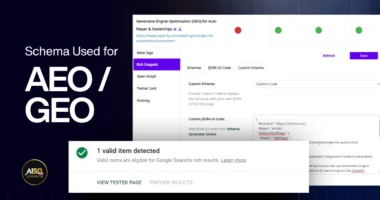
Schema Used for AEO / GEO: The Truth About the schem...


Generative Engine Optimization for Marketers (GEO for Marketers) is the practice of writing and structuring content so AI answer engines like ChatGPT, Perplexity, Google AI Overviews, and Gemini quote or cite it directly. As of 2026, AI Overviews appear in roughly 25% of Google searches, and visitors arriving from AI platforms convert up to 8x better than traditional organic search traffic. You do not need a technical background to get started. This guide covers what Generative Engine Optimization actually is, why marketing teams must adopt it now, and the concrete formatting strategies that maximize your citation rate.
Generative Engine Optimization for Marketers is defined as the strategic practice of creating, structuring, and formatting web content so AI-powered answer engines can easily extract, verify, and cite it within synthesized responses. While traditional SEO competes for a top rank among blue links, Generative Engine Optimization focuses on winning the direct sentence or source link inside an AI-generated answer.
The term originates from a 2024 peer-reviewed study by researchers at Princeton University, Georgia Tech, the Allen Institute for AI, and IIT Delhi. Their testing of nine optimization methods across 10,000 real queries demonstrated that specific techniques—such as integrating statistics, citing named sources, and embedding direct quotes—boosted a page’s visibility in AI search results by up to 40%.
For marketing teams, successful Generative Engine Optimization for Marketers means shifting your content goal from merely “ranking #1” to becoming the authoritative source an AI model quotes to solve a user’s problem.
Because the traffic and buying behavior of your audience has already moved to AI platforms, whether your content is ready for it or not. The numbers make the shift concrete.
| Metric | Data point | Source |
|---|---|---|
| Share of Google searches showing an AI Overview | About 25% | Seer Interactive, First Page Sage, 2026 |
| Organic click through rate drop when an AI Overview appears | 61% lower | Seer Interactive, 2025 |
| Visitor conversion rate from ChatGPT referrals | 14.2% to 15.9% | Seer Interactive, 2025 |
| Visitor conversion rate from Perplexity referrals | 10.5% | Seer Interactive, 2025 |
| Visitor conversion rate from Google organic search | 1.76% | First Page Sage, 2026 |
| Overlap between Google’s top ten results and AI citations | Down from about 75% in mid 2025 to 17% to 38% in early 2026 | BrightEdge, Demand Local, 2026 |
| Content type most frequently cited in AI answers | Comparison articles, 32.5% of citations | Previsible AI Traffic Report, 2025 |
Two things stand out here for a marketer. First, a page ranking on Google’s first page is no longer a reliable predictor of AI visibility, since the overlap between the two has collapsed. Second, someone who does land on your site through ChatGPT or Perplexity is far more likely to become a customer than someone arriving through a regular search click. Chasing AI citations is not a defensive move, it is a growth channel.
GEO and SEO share a foundation, technical health, clear writing, and topical authority, but they optimize for different outcomes. SEO optimizes for a ranked position a human scrolls through. GEO optimizes for a sentence a machine selects and repeats.
| Traditional SEO | Generative Engine Optimization |
|---|---|
| Goal: rank in the top positions of a results page | Goal: be the source an AI answer quotes or paraphrases |
| Success measured by clicks and rankings | Success measured by citation frequency and share of voice inside AI answers |
| Relies heavily on backlinks and domain authority | Relies heavily on clear entity naming, statistics, and direct answers |
| Keyword matching drives visibility | Question matching and natural phrasing drive visibility |
| One click, one visit | One citation can influence a decision with zero visits, since the reader may never click through |
Both disciplines still matter in 2026. A page with weak SEO fundamentals, slow load times, no schema markup, thin content, rarely gets crawled deeply enough to be cited either. Treat GEO as a layer built on top of solid SEO, not a replacement for it.
AI engines favor content that answers a question clearly, states facts in a way that can stand alone, and backs claims with named sources. Perplexity, ChatGPT, and Google AI Overviews each pull from slightly different index sources, but they share the same underlying preference for content that reads like a direct, well supported answer rather than a marketing pitch.
In practice, this means the model is scanning for a small set of signals:
You can start improving your AI visibility this week without touching a line of code. Focus on these five habits across your existing content library first.
To align your writing with Generative Engine Optimization for Marketers, follow a top-heavy content architecture:
Frame Headings as Real Prompts: Convert generic labels like “Content Marketing Benefits” into natural language queries like “What Are the Main Benefits of Content Marketing for B2B Brands?”
Target Ideal Word Counts: Aim for comprehensive coverage between 1,300 and 1,800 words to provide authority without fluff.
Use Functional Tables: Use Markdown tables exclusively for comparative data, pricing metrics, and feature matrixes.
Maintain Content Timestamps: Ensure visible “Last Updated” dates on all published assets to preserve freshness signals.
Track it the same way you would track keyword rankings, but for AI answers instead of search results. Run your target questions directly through ChatGPT, Perplexity, and Google AI Overviews on a regular schedule and record whether your brand appears, how it is described, and which competitor shows up instead when it does not. Tools like HubSpot’s AI Search Grader and Semrush’s AI visibility tracking features can automate part of this process, but manual prompt testing still catches nuance that dashboards miss.
Pay attention to sentiment as well as presence. BrightEdge reported that AI Overviews surface negative sentiment in about 2.3% of brand mentions, compared with 1.6% for ChatGPT, so being cited is not automatically a win if the surrounding context is unflattering or inaccurate.
Is GEO the same thing as SEO? No. GEO and SEO overlap in fundamentals like clear writing and site health, but SEO optimizes for ranking position while GEO optimizes for being cited inside an AI generated answer.
Do I need coding or schema markup knowledge to start with GEO? No. The highest impact GEO habits, clear definitions, named entities, statistics with sources, and short paragraphs, are writing and editing changes anyone on a marketing team can apply directly in a CMS.
How long does it take to see results from GEO? Most brands see measurable improvement in AI citation frequency within four to eight weeks of applying proper GEO structure, since engines like Perplexity and Google AI Overviews pull live data and can reflect changes faster than traditional search rankings.
Which content format gets cited most often by AI engines? Comparison articles currently lead, accounting for about 32.5% of AI citations, followed by opinion and expert commentary pieces.
Should I stop investing in traditional SEO? No. GEO builds on top of SEO fundamentals rather than replacing it. Pages with weak technical SEO rarely get crawled deeply enough to be considered for citation in the first place.

Gateway to AI Adoption. This is the Future of Marketing.
Schema Used for AEO / GEO: The Truth About the schem...

14 Days Journey to GEO - Day 2 Yesterday, you began ...
AISQ Progress Update #9 – One-Click Internal Links, a...